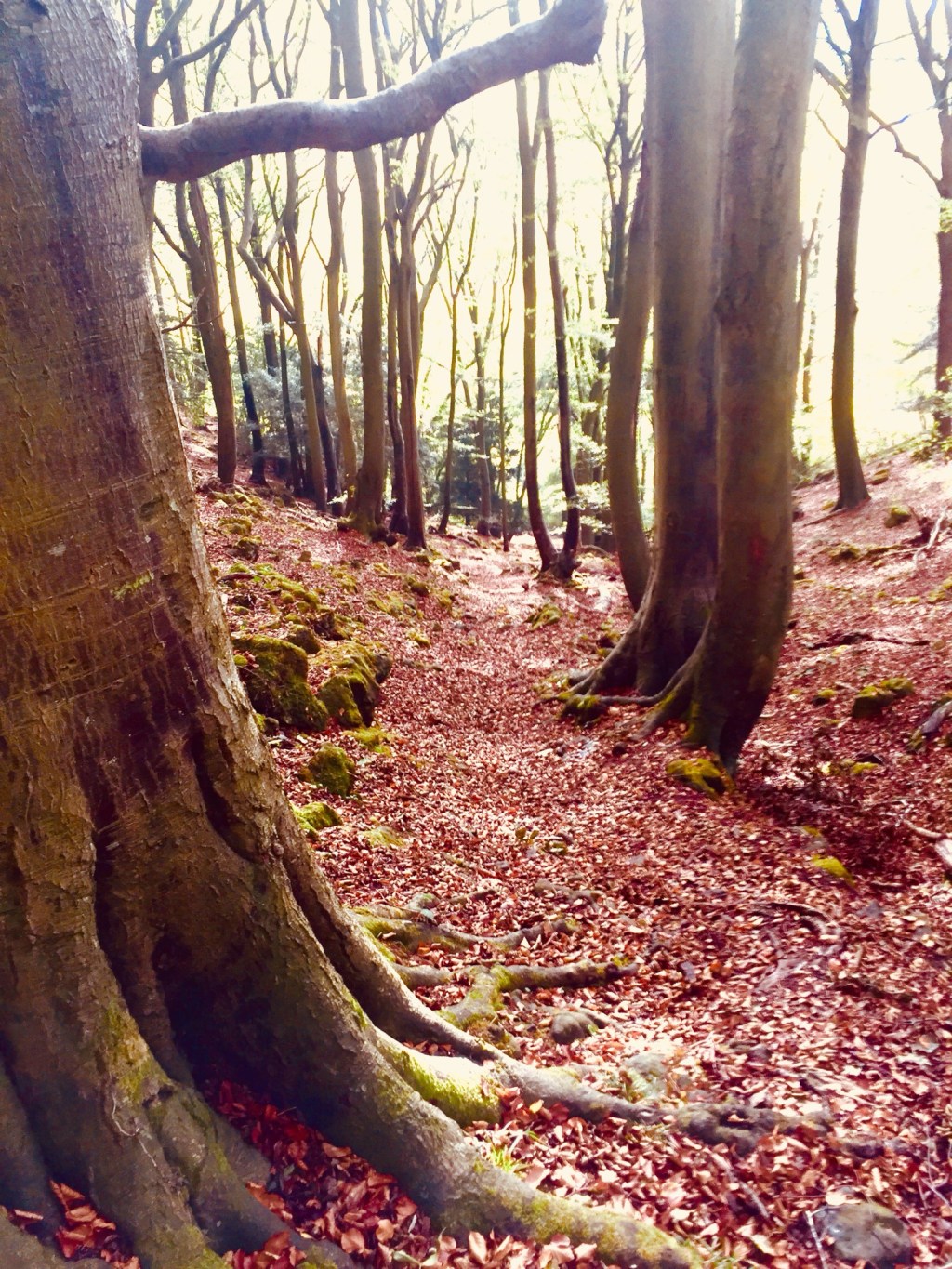
Trees share nutrients and other compounds with each other via a network of microrrhizal connections. A variety of fungi connect the rootlets of trees with each other to make a complex web of connectivity. The fungi are of various types, some are specific to particular tree species and some more catholic. Some fungi send their hyphae deep between and within the tree root cells and some connect more superficially. A variety of compounds are exchanged through these networks including nutrients and chemical messengers. It is truly astonishing that trees can connect in this way and over considerable distances. They can not only connect with their own species but can communicate, through fungi, to trees of different species. The mechanism for this communication was discovered by the forester Suzanne Sinard who spent decades experimenting mostly by feeding trees radioactive carbon dioxide and watching where it went. The connectivity was christened, by other people, the ‘Wood Wide Web’ and the name stuck. Sinard was widely criticised by the scientific community for her work, and it took several decades until unrelated academics replicated her findings and extended her research. The Wood Wide Web is now part of the canon on ecology, and Sinard’s breakthrough recognised as the biggest step forward in botanical analysis of our generation.
The attack from scientists on Sinard’s results paled into insignificance against the profound onslaught she received about some related ideas she propounded. Sinard believed that trees were passing nutrients and messages to other trees to help them thrive. She also believed that trees recognised and favoured their own offspring in this process. She talked about ‘Mother Trees’ protecting and supporting both their own and unrelated saplings, before making way for them through their death. She captured this in her excellent autobiographical work – Finding the Mother Tree. In emphasising the cooperation between trees, and indeed between trees and microrrhizal fungi, Sinard stumbled upon an historic argument. Traditional interpretations of Darwin’s theory of evolution relied strongly on a view of each species battling against each other for supremacy. This continuous war provided the driving force for evolution where the ‘fittest’ survived. This model was strongly challenged by the Russian Peter Kropotkin who showed how inter and intra species collaboration provided optimum conditions for biodiversity and ecological sophistication. It was, according to him, through the principle of mutual aid that evolution occurred. Debate between these two apparently inconsistent positions continued through the twentieth century and into the twenty first. The former view has been described as a colonialist model, whilst Kropotkin’s sits within the context of his own anarchism.
It is possible to detect these threads in current popular writing, especially as her work and that of other botanists has brought woodland ecology onto the best-sellers lists of bookshops. The German forester Peter Wollehben has written a series of very good books from firmly in the Sinard camp. He talks eloquently about the interdependence of trees and fungi in the woodland landscape. Tristran Gooley on the other hand has written a series of, also very good, books emphasising the competitive aspects of tree interaction, demonstrating how the growth patterns of trees show the accommodation which has been made to maximize resource potential. Fundamentally the difference between these two positions might be more of a difference in perspective than of empirical science. Sinard’s groundbreaking work has shown the mechanism by which nutrients are passed between one tree and another. It is not clear whether this action is more accurately described as a gift or as a theft.
DNB Jan 2026
 the Crows Nest
Leave a comment